The ALTO Survey Is Hiding the “Strongly Disagree” Option
The ALTO Survey Is Hiding the “Strongly Disagree” Option
A design flaw in the consultation questionnaire makes the most critical response choice invisible to most participants — and Alto needs to acknowledge it before the March 29 deadline.
The Alto public consultation closes March 29, 2026. If you have not yet submitted your feedback — or wish to submit additional comments about this survey flaw — visit en.consultation.altotrain.ca.
The Alto consultation survey presents its response options in a horizontal row that extends beyond the visible screen. The fifth and final option — “Strongly Disagree” — is partially or fully hidden unless the user knows to hover over the question row and scroll sideways. Most participants will complete the survey without ever seeing it. This is likely artificially skewing Alto’s results away from the strongest expressions of opposition.
From an open house conversation to a confirmed flaw
This issue first came to my attention through a community member who had completed the Alto consultation survey and reported that it appeared to offer only four response options — with no “Strongly Disagree” available. They raised this concern directly with me.
I raised it in turn with Pierre-Yves Boivin at the Alto open house in Storrington. His initial reaction was surprise — he was not aware of the problem. He later came back to me during the session and showed me the survey on his phone, pointing out that all five options do technically exist in the questionnaire.
He was right. But that answer missed the point. That evening, I went to the survey myself and found exactly what the community member had described. The “Strongly Disagree” option exists — but on most screens, it is invisible unless you know to interact with the row in a very specific way.
“When I loaded the survey on my screen, the response options showed Strongly Agree, Somewhat Agree, Neutral, and Somewhat Disagree — and then a partial, cut-off label at the right edge. ‘Strongly Disagree’ was not visible. You have to hover over the row and drag it to the left to reveal it.”
The screenshot below, taken from the Alto consultation questionnaire, shows exactly this: the response scale for each question extends off the right edge of the screen. The rightmost visible text is a fragment — “Stro…” — which is the beginning of “Strongly Disagree,” cut off mid-word.
Screenshot of the Alto Consultation Questionnaire showing the Strongly Disagree option cut off at the right edge of the screen, visible only as “Stro…” on each question row.
Note the right edge of each question row: the response options Strongly Agree, Somewhat Agree, Neutral, and Somewhat Disagree are visible, but the fifth option — Strongly Disagree — is cut off. Only a fragment reading “Stro…” is visible. Without scrolling horizontally within the row, most users will not see it.
What users see — and what they’re missing
A standard five-point Likert scale — the format Alto is using — should present all five options with equal visual prominence.
Somewhat agree
Neutral
Somewhat disagree
Strongly disagree
Somewhat agree
Neutral
Somewhat disagree
Stro…
Off-Screen
⚠ “Strongly Disagree” is not visible without horizontal scrolling within the row — a non-obvious interaction most users will not discover.
How to find the hidden option
If you have already started or submitted the survey, try the following: hover your cursor directly over the row of a question you want to answer, then click and drag the row to the left, or use a horizontal scroll gesture on a trackpad. On mobile, try swiping left within the question row itself. The “Strongly Disagree” option will appear from behind the right edge. This interaction is not signalled anywhere on the page — there is no scroll indicator, no arrow, no visual cue that a fifth option exists.
This is not a minor inconvenience — it affects the integrity of the results
Alto has opened a public consultation specifically to gather community input on the proposed route. The responses to this survey will inform Alto’s recommendation to the federal government on which corridor to build. The strength of public opposition — or support — is a material input to that decision.
A Likert scale that systematically hides its strongest negative option does not produce valid data. It produces artificially moderated results.
The communities most affected are also the most opposed
Stone Mills, Rideau Lakes, and South Frontenac have all passed unanimous council motions opposing the southern corridor. Many residents hold strongly negative views — not mildly negative ones. Forcing those residents into “Somewhat Disagree” when they intended “Strongly Disagree” understates the intensity of local opposition. Survey methodology is clear: collapsing a 5-point scale to an effective 4-point scale changes the distribution of results, particularly at the extremes.
“Strongly Disagree” carries the most signal
In a consultation on a controversial infrastructure project, the proportion of respondents choosing “Strongly Disagree” is arguably the single most important data point. It indicates intensity of opposition, not just direction. If that option is effectively invisible, the consultation is not measuring what it claims to measure. Any report that presents the results without acknowledging this flaw will be misleading.
The flaw disproportionately affects less technically confident users
A younger, more technically experienced user might instinctively try scrolling horizontally when a UI element looks truncated. An older or less technically experienced user — a category that describes a substantial portion of the rural Eastern Ontario residents most directly affected — will simply not see the option and will select “Somewhat Disagree.” This creates a systematic bias, not a random one.
The consultation is already partway through its window
The survey opened in January 2026 and closes March 29. A significant number of responses have presumably already been submitted — including by people who never saw “Strongly Disagree.” Those responses cannot be recalled and corrected. Every day this flaw goes unacknowledged, more responses are collected under flawed conditions.
I am not suggesting that Alto or its contractors deliberately designed the survey to hide the “Strongly Disagree” option. This is almost certainly an inadvertent technical problem — a responsive design failure where a horizontal table or flex layout was not tested across all screen sizes and devices. But inadvertent or not, the effect on the data is real, and the obligation to acknowledge and address it is the same.
Alto must acknowledge and address this flaw before the deadline
This is a solvable problem — but only if Alto acts quickly and transparently. The following steps are the minimum required to preserve the integrity of the consultation.
Fix the survey interface immediately
The response options must be visible on all screen sizes and devices without any non-obvious scrolling or hover interaction. If the horizontal layout cannot be made to work responsively, switch to a vertical or stacked layout for the response options. This is a straightforward CSS fix.
Issue a public acknowledgement of the flaw
Alto should post a notice on its consultation platform confirming that a display issue affected the visibility of “Strongly Disagree” responses, that it has been corrected, and that previously submitted responses may not have reflected respondents’ intended answers.
Allow affected respondents to revise their submissions
Anyone who completed the survey during the period when “Strongly Disagree” was not visible should be given the opportunity to review and, if they wish, update their responses.
Disclose the flaw in any reporting of results
Any report, summary, or briefing document that uses data from this survey must include a clear note about when the flaw existed, how many responses were collected during that period, and what steps were taken to mitigate its effect on the data.
Do not use uncorrected data to justify a route decision
If Alto proceeds to a route recommendation without addressing this issue, the integrity of the entire consultation process is compromised. Communities affected by the southern corridor have a right to expect that their opposition — including its intensity — is accurately captured and reported.
If you have already submitted the survey
If you completed the Alto consultation survey and did not see a “Strongly Disagree” option, your response may not have captured your actual view. Here is what you can do:
Return to the survey and check for the hidden option
Visit en.consultation.altotrain.ca and look at the response rows. Hover over a question row and try scrolling left within it. If you see “Strongly Disagree” appear from behind the right edge, the flaw is confirmed on your device. If the survey allows re-submission or revision, use it.
Contact Alto directly to report the issue
Use the contact form on the Alto consultation platform to report that you were unable to see the “Strongly Disagree” option when you submitted your response, and that you wish to register a “Strongly Disagree” answer for affected questions. Keep a record of your communication.
Use the comment box to state your position explicitly
If you cannot revise your radio button answers, the open comment box is your best opportunity to make your actual level of disagreement clear. Write explicitly that you intended to choose “Strongly Disagree” on specific questions but were unable to see that option, and state your position in plain language.
Share this information with other community members
Anyone who has already submitted — or is planning to submit — the Alto survey should be aware of this issue. Share this post, talk to neighbours, and raise it at any community meetings or council sessions where the Alto consultation is being discussed. The more people who report this flaw directly to Alto, the harder it becomes to ignore.
The deadline is March 29, 2026
The Alto public consultation closes on March 29. If you have not yet submitted your feedback — or wish to submit additional comments about this survey flaw — raising the survey design issue directly in your submission is a legitimate and important part of the public record.
Inside the ALTO Open House: Observations from Storrington
Inside the ALTO Open House: Observations from Storrington
What was said, what shifted, and what remains unanswered.
Yesterday’s ALTO open house in Storrington drew concerned residents, engaged councillors, and at least one very prepared attendee armed with 33 questions. Here’s what we learned — and what still remains frustratingly unclear.
A story still being written
A conversation with David Cook, ALTO’s VP of Systems and Interfaces, indicated the southern route was added partly to provide a second option for consideration.
On costs, the story seemed to shift depending on who you asked and when. In the afternoon, Cook suggested the southern route was more expensive. By evening, senior representatives were saying there was no meaningful cost difference between the two routes.
One has to wonder whether community feedback — and those heat maps of social media sentiment — may be quietly influencing how cost narratives are framed.
Key issues raised at the open house
Materials and Costing
Cook acknowledged that the project is largely a materials-handling exercise and that the cheapest material sources would be sought. A holistic costing approach, however, didn’t appear to be part of the conversation. When asked about bridges and overpasses, senior staff were unable to provide average costing of these structures and couldn’t recall that one of their own team had mentioned minimizing overpasses at a Kingston City Council meeting the night before.
Land and Expropriation
Buildings will apparently be avoided where possible (they’re expensive), but portions of private land remain fair game. This would potentially leave homeowners uncompensated for living with the rail line essentially in their (now smaller) backyard.
Municipal Road Damage
On the subject of the anticipated effect of truck and construction vehicle traffic on rural roads, suppliers will be held responsible for damage to municipal roads.
Unanswered questions and missed details
Heritage Site Confusion
There appeared to be some confusion among ALTO representatives about which heritage sites fall within the southern corridor — specifically, a possible mix-up between Frontenac Arch Biosphere (FAB) and the Rideau Canal UNESCO heritage designation. These are not the same thing, and the distinction matters enormously for route assessment.
Indigenous Lands
ALTO stated that the chosen corridors do not touch Indigenous lands. However, questions remain about unceded territories within the Frontenac Arch. This deserves expert scrutiny and a clear, documented answer — are there not unceded territories in the Frontenac Arch? Is anyone an expert on this?
Environmental Studies: Backwards Process
Detailed environmental and other impact studies will apparently only be conducted after route selection. To many community members, this seems backwards — understanding environmental impacts should inform route decisions, not follow them.
On the tools and the process
Chief Communications and Engagement Officer Pierre-Yves Boivin seemed caught off guard by the suggestion that an interactive online map may not be the most inclusive engagement tool. His suggested alternative — comment boxes on a survey — drew further skepticism. Getting meaningful feedback from a broad cross-section of the public requires more than digital forms.
On a more encouraging note, a representative from Queen’s University Biological Station (QUBS) gave the ALTO team a thoughtful and pointed lesson on local ecological concerns. And many South Frontenac Councillors were present and visibly engaged — a welcome sign that local voices are being brought to the table.
Vigilance remains essential
Questions are being asked. Some are being deflected, some genuinely can’t yet be answered, and a few are revealing inconsistencies in ALTO’s own messaging. Community vigilance — and continued pressure for transparent, holistic, and inclusive engagement — remains essential.
More updates to follow as the consultation process continues.
33 Questions. Few Answers.
Consultation Accountability
33 Questions. Few Answers.
How Alto responded to detailed public consultation questions about the Eastern Ontario route selection
Alto HSR Citizen Research · March 2026
Summary
In March 2026, Alto HSR Citizen Research submitted 33 detailed questions to Alto as part of the formal public consultation on Eastern Ontario route selection. The questions were organized into 8 themes and designed to elicit specific, evidence-based responses. Alto replied with 8 thematic paragraphs that did not reference individual question numbers, allowing general statements to stand in for specific answers.
Of 33 questions: 1 was reasonably answered, 4 were partially answered, 5 were acknowledged but deferred, 9 received only generic language that did not address the specific question asked, and 14 were completely ignored.
The Numbers
Response Scorecard
Alto restructured the submission into theme-based paragraphs rather than answering each question individually. This allowed them to address a topic in broad terms while bypassing the specific, pointed questions within it. The full questions-and-analysis are set out below, organized by theme.
Key Findings
The Most Significant Gaps
Geotechnical studies have not been done (Q2)
Alto admitted that “in-depth geotechnical studies will be able to take place once we have an alignment.” They are selecting a corridor before doing the geological work to evaluate it — and asking the public to comment on route options that haven’t been geologically assessed.
The Frontenac Arch was not mentioned (Q14)
Asked directly how Alto would mitigate bisecting the Frontenac Arch UNESCO Biosphere Reserve, Alto did not mention the Frontenac Arch at all. This is arguably the most environmentally significant question in the submission, concerning a globally recognized ecological corridor. It was completely ignored.
Wells and septic: “too early” (Q29–Q30)
Alto dismissed both groundwater questions as “too early” and referenced field studies that cover surface water and aquatic habitat — not groundwater hydrogeology, not private well impacts, not septic system vulnerability. The question about setback distances from wells (Q30) was not acknowledged. Read our full analysis of well and septic impacts →
HS2 was not named (Q3)
Asked specifically about lessons from the UK’s HS2 project — the most directly comparable HSR project in the English-speaking world, and one with a well-documented history of cost overruns and community disruption — Alto said only that they had reviewed “a range of recent large-scale rail and infrastructure projects.” No project was named. No specific lesson was identified.
Adjacent property owners get nothing (Q19)
Whether property owners whose land is adjacent to — but not expropriated by — the corridor would receive compensation for loss of property value was completely ignored. This question affects potentially thousands of properties along any corridor.
No per-kilometre cost comparison (Q32)
Alto repeated the publicly known $60–$90 billion estimate but refused to provide per-kilometre cost comparisons to international HSR projects. This is the calculation that would reveal whether their estimates are realistic relative to comparable projects worldwide.
Full Analysis
Question-by-Question Assessment
Below is each of the 33 questions submitted, followed by an assessment of Alto’s response. Questions are colour-coded: Answered Partial Deferred Generic Ignored
1. Route Selection and Evidence Base Q1–Q4
Q1 What criteria are being used to evaluate and compare the Northern and Southern route options, and how will each criterion be weighted?
Alto listed general objectives but provided no criteria list, no weightings, and no comparison framework. If the public cannot see how route decisions are scored, the consultation is performative.
Generic
Q2 What geological analysis has been conducted to inform route selection? Have independent experts reviewed Alto’s geological and geotechnical assumptions?
Alto admitted geotechnical studies will happen after an alignment is selected. This means they are asking the public to comment on route options that have not been geologically assessed. The question about independent expert review was not addressed.
Deferred
Q3 How do you plan to incorporate lessons learned from comparable international projects — specifically the UK’s HS2?
Alto said they reviewed “a range of recent large-scale rail and infrastructure projects” but refused to name HS2 or any specific project and identified no specific lessons. The question asked about a specific, well-documented cautionary example, and they genericized it.
Generic
Q4 Is it Alto’s priority to use existing transportation corridors, to avoid populated areas, or some other principle? Where these objectives conflict, how will trade-offs be resolved?
Alto restated the objectives but provided no conflict-resolution framework. The question specifically asked what happens when objectives contradict each other.
Generic
2. Aggregate, Materials, and Waste Q5–Q8
Q5 How much aggregate per kilometre is required for each route? Please provide figures for both the Northern and Southern options.
Alto gave a network-wide ballast estimate but no per-kilometre figures and no route comparison. The entire point of the question was to compare the two routes, and that comparison was dodged.
Partial
Q6 Where will aggregate be sourced from for each route?
No answer. Sourcing will be determined after alignment selection.
Deferred
Q7 How much excavated material will require disposal in landfill? Where are the proposed disposal sites?
No answer. Disposal sites to be “identified during procurement.”
Deferred
Q8 What are the estimated CO₂ emissions associated with transporting aggregate and construction materials to each route?
Completely ignored. Not acknowledged in any form.
Ignored
3. Municipal Roads and Construction Traffic Q9–Q12
Q9 What is the estimated volume of construction truck movements on municipal and county roads for each route (e.g. Perth Road, Opinicon Road, Highway 15)?
No estimate provided. Deferred to after alignment selection.
Generic
Q10 How will Ontario’s seasonal road load restrictions affect construction timelines and logistics planning?
Completely ignored.
Ignored
Q11 Who will be responsible for funding road repairs caused by construction traffic? What compensation mechanism will be in place?
Alto said they’d “work with municipalities to mitigate potential impacts” but made no commitment on funding responsibility, described no compensation mechanism, and did not acknowledge the HS2 Buckinghamshire precedent raised in the question.
Generic
Q12 Will Alto require or incentivise use of existing rail corridors to deliver aggregate, reducing truck movements on local roads?
Completely ignored.
Ignored
4. Environment, Species, and Biodiversity Q13–Q17
Q13 How will Alto estimate and quantify the impact of each route on Species at Risk under SARA? What threshold of species impact is considered acceptable?
Alto referenced the federal Impact Assessment and field studies but described no methodology and identified no thresholds.
Generic
Q14 How does Alto propose to mitigate the environmental consequences of bisecting the Frontenac Arch UNESCO Biosphere Reserve, should the Southern Route be selected?
Completely ignored. The Frontenac Arch is not mentioned anywhere in the response. This is arguably the most environmentally significant question in the entire submission.
Ignored
Q15 What is the estimated loss of carbon sequestration capacity from clearing vegetation along each route corridor?
Completely ignored.
Ignored
Q16 Will a full quantitative analysis of dead-ended municipal roads and severed property access be conducted for both routes?
Alto said it is “too early to determine the specific impacts on individual roads” but made no commitment to the quantitative analysis requested.
Generic
Q17 Is each affected municipality responsible for managing dead-end road situations? Will Alto fund road diversions?
Alto said they would minimize parcel-splitting and provide “indirect routes or detours,” but the core question — who pays — was not answered.
Generic
5. Property, Expropriation, and Compensation Q18–Q24
Q18 What buffer distance will be maintained between the HSR corridor fence line and adjacent inhabited properties?
Completely ignored.
Ignored
Q19 Will property owners whose land is adjacent to but not expropriated receive any compensation for loss of property value, amenity, or enjoyment?
Completely ignored. This affects potentially thousands of properties along any corridor.
Ignored
Q20 How will expropriation values be determined? Will compensation be based on pre-announcement values? Will moving expenses, legal fees, and business disruption be covered?
Alto said compensation would be based on market value “excluding any increase or decrease related to the project,” which implies pre-announcement equivalent values. However, moving expenses, legal fees, and business disruption were not addressed.
Partial
Q21 How will people be compensated if they lose road access to a waterfront or rural property?
Completely ignored.
Ignored
Q22 Will expropriation proceed in phases aligned with construction staging, or will all affected landowners be expropriated simultaneously?
Completely ignored.
Ignored
Q23 What happens to expropriated properties if the HSR project is cancelled, as occurred at Mirabel Airport and Pickering Airport?
Completely ignored. A politically uncomfortable question with well-known Canadian precedents.
Ignored
Q24 Will Alto make use of temporary occupation of private land? What compensation will be paid, and will full remediation be guaranteed?
Alto provided a substantive answer: temporary access will be voluntary, compensation will be paid, and Alto “undertakes to restore the site to a condition comparable to its original state.” This is the most specific commitment in the entire response.
Answered
6. Noise, Vibration, and Amenity Q25–Q28
Q25 What are the predicted noise levels at various distances from the track compared to current ambient levels?
No data provided. Deferred to after route determination.
Deferred
Q26 What levels of vibration are anticipated during construction and operations?
No data provided. Same deferral.
Deferred
Q27 What design standards will govern noise and vibration mitigation — berm heights, acoustic barriers, track isolation?
Alto listed generic construction-phase measures (temporary barriers, white-noise alarms, quieter equipment) but provided no design standards, no berm specifications, and no track isolation details. These are construction measures, not the operational design standards asked about.
Partial
Q28 How high will security fencing be? Will there be video surveillance, and how will privacy be protected?
Alto confirmed “fences and controlled access” but gave no fence specifications. The surveillance and privacy question was completely ignored.
Partial
7. Groundwater, Wells, and Septic Systems Q29–Q30
Q29 How will HSR construction and operations affect groundwater, private wells, and septic systems in the corridor? What assessment methodology will be used?
Dismissed as “too early.” The field studies referenced cover surface water and aquatic habitat, not groundwater hydrogeology or private well impacts. Alto is asking the public to comment on routes before understanding what those routes would do to the water systems rural families depend on.
Ignored
Q30 What minimum setback distances are planned between the rail corridor and private wells and septic beds? How will vibration transmission through limestone bedrock be assessed?
Not acknowledged at all — not even with a “too early” deferral. The specific technical question about limestone vibration transmission was entirely overlooked.
Ignored
8. Financial Accountability and Project Viability Q31–Q33
Q31 What ticket price will be required to support the business case, and at what ridership level? Will this analysis be made public before route selection?
Alto said fares would be “competitively priced” but provided no price range, no ridership threshold, and no commitment to pre-route-selection disclosure.
Generic
Q32 How likely is the project to be delivered on budget? What contingency provisions have been made? How do cost estimates compare to international HSR projects on a per-kilometre basis?
Alto repeated the publicly known $60–$90 billion figure and described cost management in general terms, but provided no contingency figures and no per-kilometre comparison to international projects. The per-km comparison is the calculation that would reveal whether their estimates are realistic.
Generic
Q33 How long will construction last in each specific area? What will be the minimum notice period given to affected landowners?
Completely ignored.
Ignored
What This Means
Why These Gaps Matter
Alto’s response reveals a consultation process that cannot deliver informed public input. The public is being asked to express preferences between route options without access to the geological analysis, cost comparisons, environmental assessments, noise data, or groundwater studies that would allow a meaningful evaluation.
The pattern of Alto’s responses is consistent: questions seeking specific data or commitments are deferred or ignored, while questions that can be addressed with general assurances receive vague responses. The one substantively answered question (Q24, temporary land access) was the topic where Alto’s response was most advantageous to its own interests — establishing voluntary participation and limiting its restoration obligation to “comparable” rather than identical condition.
Several questions raised well-documented international precedents (HS2 cost overruns, Mirabel/Pickering Airport expropriations, CN/CPKC drainage disputes) that would have required Alto to engage with uncomfortable realities. In every case, the specific precedent was not acknowledged.
A consultation that asks the public to choose between options while withholding the information needed to evaluate those options is not a genuine consultation. It is a process designed to produce the appearance of public input without the substance.
What Alto Said — and Didn’t Say
Alto held a national virtual public consultation on March 3rd. Hundreds of questions were submitted. Dozens were answered. Many of the most important were not. Here is what the transcript reveals.
The Session at a Glance
The March 3rd virtual session ran for approximately two hours and featured three pre-recorded video presentations interspersed with three live Q&A blocks. Four Alto representatives answered questions: Pierre-Yves Boivin (Communications), Nicolas de la Hous (Land Management), Jason Boivin (Impact Assessment), and Mavara Turab (Engineering).
The format was controlled: written questions only, submitted through an online form, selected and grouped by the moderator. There was no opportunity for follow-up. This structure is worth noting — it is not designed for accountability. It is designed to manage it.
The session was professional and well-run. Alto’s communications team is clearly skilled at conveying reassurance. That is not the same thing as conveying information.
Where Alto Was Credible
Expropriation messaging was clear and consistent
Land manager Nicolas de la Hous answered multiple property questions with a coherent and specific message: all contact begins with an Alto representative speaking directly to landowners, expropriation is a last resort, fair market value is the baseline, and no one will ever receive their first notice by email. This level of consistency suggests genuine preparation based on anticipated community anxiety — and it was the most credible performance of the session.
Environmental answers showed genuine familiarity
Impact assessment manager Jason Boivin gave the session’s most substantive technical answers. He described trail camera studies, referenced the federal IAA process correctly, and discussed wildlife corridor mitigation with appropriate nuance. His acknowledgment that best practices from other jurisdictions are being reviewed, including for cold climates, was credible.
The case for dedicated infrastructure was well made
When asked why VIA Rail’s existing infrastructure can’t simply be upgraded, Pierre-Yves Boivin gave a coherent answer: freight rail dependency means VIA trains are regularly sidetracked, and 300 km/h speeds require dedicated electrified track that the existing network simply cannot support. This is accurate, and it was explained clearly.
Where Alto Deflected
Several questions received answers that sounded responsive but, on examination, contained very little substance. These are worth examining carefully.
“$60–$90 billion” with no payback answer
When asked about the project’s payback timeline and fiscal discipline, Alto pivoted to its GDP uplift talking points ($24 billion, 1.1% of GDP over the project’s lifespan). These are promotional figures, not financial accountability. The actual question — how long before taxpayer investment is recovered, and under what model — was never answered.
Alto’s cost estimate is $60–$90 billion for a project that has not completed basic engineering. International comparators like the UK’s HS2 — which opened at three times its original estimate — suggest this range deserves independent scrutiny.
“Affordable fares” declared, not explained
Asked how affordable fares can be guaranteed when project costs are not yet determined, engineering VP Mavara Turab answered: “That’s our mandate.” This is circular. There was no reference to fare-setting mechanisms, subsidy structures, or how student-accessible pricing would be maintained as costs escalate. Stating a goal is not the same as having a plan to achieve it.
The technology obsolescence question was not answered
When asked how Alto can be confident that technology chosen today will still be relevant in 20 years, Mavara Turab responded that high-speed rail “is tried and tested at the global scale.” This completely misses the point. The question was about future relevance over a two-decade construction window — not current maturity. No mention of modular procurement design, technology refresh provisions in contracts, or how rapid advances in train control systems would be accommodated.
Field study data is being withheld during consultation
A participant from Quinte West asked why environmental field study results from 2020–2024 are not publicly available during the consultation period. Jason Boivin’s answer — “we’re still compiling them” and “we’re focused on 2026 studies” — is not satisfying. These studies were conducted years before public consultation opened. Asking the public to provide meaningful input while withholding baseline environmental data is a structural transparency problem. It deserved a direct answer and received deflection.
Corridor framing revealed a preference without acknowledging it
Describing the northern (Canadian Shield) option as involving “more complex work in remote and sensitive areas” while the southern option “could simplify construction” is leading language. It encodes a preference for the southern route without disclosing that preference, and without offering any honest accounting of the southern route’s own complexities — including karst geology, Frontenac Arch Biosphere protections, and higher population density impacts.
The Questions That Were Never Asked
Some of the most important issues facing this project did not appear in the Q&A at all — either because participants didn’t raise them, or because they were filtered out. These gaps are as informative as the answers that were given.
No questions about international overrun history — HS2, California HSR, or the Oxford/Flyvbjerg research showing rail megaprojects overrun budgets by an average of 44.7%.
No mention of the karst limestone and glacial till conditions along the southern route that make tunnelling, foundations, and drainage significantly more complex — and expensive.
No questions about the Frontenac Arch UNESCO Biosphere Reserve, the recently designated Thousand Islands Key Biodiversity Area, or the grey ratsnake critical habitat that the southern corridor bisects.
No discussion of how proposed changes to the Impact Assessment Act under Bill C-15 could affect the environmental review process for this project — or what provisions are needed to ensure its independence.
Alto discussed winter operations including de-icing, but no questions were raised about chemical runoff into karst watersheds — particularly relevant to the southern corridor where fractured limestone creates direct pathways to groundwater.
No challenge to Alto’s McGill TRAM-based claim that the project can approach financial self-sustainability — a claim that independent analysis suggests is highly optimistic under reasonable ridership and cost scenarios.
Power demand figures contradicted each other — in the same session
In the second Q&A block, Mavara Turab stated that the project’s electricity requirement is approximately 1,500 megawatts per day. In the third Q&A block, responding to a follow-up question, she cited the figure as 500 megawatts per day — one-third of the earlier number, referencing “15 to 17 new substations” in both answers.
Neither the moderator nor any other panellist noted the discrepancy. This is the kind of internal inconsistency that underscores why independent technical review — not just corporate assurance — is essential to proper evaluation of this project.
What This Tells Us About the Consultation
Alto’s public consultation is not designed to surface difficult questions. It is designed to demonstrate that consultation happened. This is not an accusation — it is simply a structural reality of how these processes work. The session was formatted to prevent follow-up, the moderator filtered questions, and the format rewarded reassurance over rigour.
The panelists who performed best — particularly on land management and environmental process — were those who gave specific, verifiable answers. The panelists who performed worst were those who answered policy and fiscal questions with mission statements.
This matters because the consultation record will eventually be used to justify decisions that are already, in some ways, in motion. What the public submits — and what it does not submit — shapes what gets analyzed. Concerned residents and communities have until March 29, 2025 to submit formal comments through altotrain.ca.
Alto’s Food Tourism Claims vs. Reality
Alto’s Food Tourism Claims vs. Reality
ALTO’s advertising promotes high-speed rail as an enhancement to Canadian food tourism. But a route through the southern corridor would travel directly through the farms, food businesses, and tourism landscapes that make that economy possible.
Alto’s public consultation is open now. Municipalities opposed to the southern corridor: South Frontenac (Feb 3), Rideau Lakes (Feb 9), Belleville (Feb 24). Kingston will oppose if no station stop is added.
$1.8 billion in regional tourism spending (RTO 9, Jan–Sep 2024). 8,744 jobs in the regional food and tourism economy. $695 million in annual GDP from the Rideau Heritage Route. 104 km of Cataraqui Trail at risk. Zero planned HSR station stops in the affected region.
Alto’s Facebook advertisement — February 2026
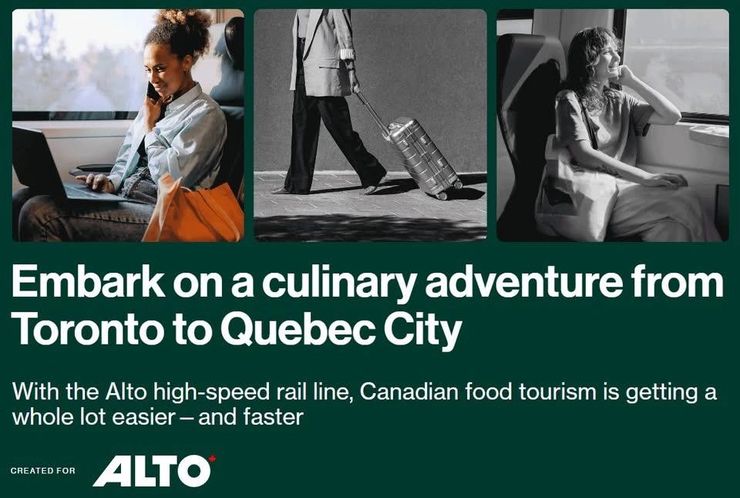
Overview: what Alto implies vs. what the southern route does
| What Alto’s advertisement implies | What a route through the southern corridor does |
|---|---|
| Connects food tourists to farm-to-table experiences | Bisects 200 km of active farmland with a permanently fenced 300 km/h barrier — farms cannot cross it |
| Makes culinary travel from Toronto to Quebec City easy | Offers zero station stops in Eastern Ontario — passengers fly past the region at speed |
| Boosts local food economies along the route | Destroys agri-tourism farms whose land is severed, isolated, or expropriated |
| Celebrates Canadian food culture | Threatens the UNESCO Frontenac Arch Biosphere — Canada’s most biodiverse region — that underpins local ecotourism |
| A positive community investment | Imposes 8–10 years of construction on farms, trails, and tourism businesses, then permanently bypasses them |
Alto’s own words — corridor comparison documents
“The southern option passes through more valuable farmland and suburban lots.” — Alto, via opencouncil.ca
That farmland is not an obstacle to build through cheaply. It is the source of the food tourism economy Alto is advertising.
The agri-food economy at risk
(RTO 9, Jan–Sep 2024)
& tourism economy
in the affected region
Eastern Ontario is not empty land. It is a working agricultural and food-tourism region. Here is what a route through the southern corridor puts at risk:
- →538 farms in Frontenac County and 537 in Lennox & Addington — primarily dairy, beef, and organic operations — the small mixed farms that supply the farm-to-table restaurants Alto is promoting.
- →$695 million in annual GDP and 8,744 jobs sustained by the Rideau Heritage Route — farming, artisan food production, local restaurants, and heritage hospitality.
- →Farm-to-table restaurants, artisan cheesemakers, wineries, breweries, and farmers’ markets that draw visitors because they sit inside an intact agricultural landscape.
- →Frontenac County alone lost 15.4% of its cropland between 2011 and 2021 — 11,254 acres gone. Removing additional farmland for rail infrastructure accelerates a crisis already underway.
The impassable barrier: why 300 km/h changes everything
Unlike a conventional railway, a 300 km/h high-speed rail line requires infrastructure that creates a permanent, uncrossable barrier through working farmland:
- →Continuous security fencing approximately 3 metres high along the entire length — no farm crossing, no trail crossing, no wildlife crossing without a costly underpass or overbridge spaced kilometres apart.
- →Complete grade separation at every intersection — every farm lane, rural road, and equipment path must be bridged or tunnelled.
- →A permanent right-of-way consuming roughly 12 acres per kilometre — approximately 1,000–1,500 acres of active Eastern Ontario farmland permanently removed.
- →No level crossings of any kind — a dairy farm severed by this line cannot move cattle between barn and pasture without driving kilometres around the barrier.
“It’s going to cut through farmland where farmers can’t go on one side or the other, they’re going to have to go all the way around… Unlike the train of old, if it went through your property, you had a crossing; you could still use your property.”
A dairy farm that cannot move cattle across its own land cannot function. A mixed livestock operation severed into two unviable parcels cannot survive. These are not abstract risks — they are the operational reality of a 300 km/h barrier through working farmland.
Tourism damage: the Cataraqui Trail & construction phase
Even before the line is operational, a decade of construction would inflict serious damage on the regional tourism economy. The most direct casualty is the Cataraqui Trail.
The Cataraqui Trail — Trans-Canada Trail
The Cataraqui Trail is a 104 km multi-use recreational trail running from Strathcona (near Napanee) to Smiths Falls — part of the Trans-Canada Trail, used by cyclists, hikers, equestrians, snowmobilers, and cross-country skiers. The Alto southern corridor alignment runs directly through it.
- →Trail closures during construction would eliminate itinerary-based cycling tourism, devastating B&Bs, outfitters, and food operators along the route.
- →The Trans-Canada Trail designation is a globally recognized brand drawing long-haul and international visitors specifically to southeastern Ontario — permanent loss would eliminate this brand entirely.
- →Friends of the Cataraqui Trail spokesperson Ron Peterson called the location “unsuitable”, noting it “crosses sensitive wetlands” and the 3-metre perimeter fence would “create a barrier across the region.”
- →Accommodation operators, wedding venues, and seasonal events businesses face a decade of construction noise and road closures on their doorstep with no compensation pathway.
All the costs, none of the benefits
International research on HSR and tourism from Spain, China, Italy, and South Korea consistently identifies a critical distinction: stations create tourism; tracks do not. The RTO 9 region has no planned station.
- →Cities where the train stops saw measurable increases in tourism arrivals and hotel revenues. Cities the train passed through without stopping saw negligible or negative effects.
- →For Eastern Ontario, the effect is to make Ottawa, Peterborough, and Toronto more accessible to each other — potentially drawing visitors away from regional day trips — while imposing all construction and operational costs on communities the train passes at speed.
- →VIA Rail displacement risk: MP Scott Reid has confirmed in writing that either HSR corridor option is likely to lead to VIA Rail service cuts through Kingston, Brockville, and other southeastern Ontario communities — removing sustainable rail access that currently brings visitors to the region.
- →UNESCO risk: The Frontenac Arch Biosphere Network was not consulted by Alto during initial planning. A 300 km/h barrier through the Biosphere’s wildlife corridors could trigger a review of the UNESCO designation — a reputational catastrophe for the region’s international tourism brand.
- →Alto is currently considering routes through the southern corridor in part because agricultural land is cheaper to build through than Canadian Shield rock. The construction cost savings accrue to the project. The costs — severed farms, damaged roads, disrupted tourism — are borne by Eastern Ontario communities.
Belleville City Council — February 24, 2026
“A route through the southern corridor will impact a swath of agricultural properties and potentially impact up to eight Quinte Conservation land holdings just in our area alone, including the Sidney Conservation Authority and the HR Frink Centre, not to mention our watershed as a whole.” — Councillor Brown, Quinte News, February 24, 2026
We’ve seen this before: HS2 in the UK
The UK’s HS2 project provides the most directly comparable evidence of what high-speed rail construction does to farming and rural tourism communities. The outcomes were severe.
| HS2 Outcome (UK) | What It Means for Eastern Ontario |
|---|---|
| 213 farm holdings directly affected — Phase One alone | Eastern Ontario’s smaller mixed farms face the same or worse, with less financial cushion to absorb multi-year disruption |
| Access infrastructure promised but not built for 7+ years | Dairy farms severed from pasture cannot operate. A promised future underpass does not keep cows milked today |
| Compensation chronically delayed; crop losses unpaid years later | Farm businesses — including agri-tourism operations — cannot survive years of uncompensated income loss |
| Farming families described “generational devastation” | Mayor Vandewal used identical language after seeing Alto’s route through the southern corridor maps in February 2026 |
| Landowners described feeling “left suicidal” after years of uncertainty | The blight period has already begun — farmland values fall the moment a corridor is announced, years before construction starts |
“Farmers along new rail proposals will be held in limbo for at least another decade, possibly even two, before work even starts.”
Note also that Bill C-15 has already amended the Expropriation Act specifically for this HSR project — eliminating the initial purchase offer requirement and shortening the landowner appeal window. Read more at Frontenac News.
What must happen before any corridor decision
This is not an argument against high-speed rail. It is an argument for an honest accounting of what a route through the southern corridor costs the food and tourism economy of Eastern Ontario.
Tourism and Agricultural Economic Impact Assessment
None has been commissioned. Alto’s socioeconomic assessments focus on productivity gains for corridor cities, not costs to rural communities.
Frontenac Arch Biosphere consultation
Formal consultation with the Frontenac Arch Biosphere Network, Parks Canada, and affected First Nations before any corridor is selected.
Binding mitigation commitments
Continuity of the Trans-Canada Trail, wildlife crossings through the Frontenac Arch, acoustic mitigation adjacent to the Rideau Canal UNESCO corridor, and construction access guarantees for tourism businesses.
High-performance rail alternative study
An independent study of alternatives up to 200 km/h that would allow level crossings, reduce right-of-way width, and potentially use existing corridors — eliminating farm severance entirely.
RTO 9 and Ministry of Tourism participation
Formal participation by RTO 9 and the Ministry of Tourism, Culture and Gaming in Alto’s consultation, quantifying the $1.8 billion in annual tourism spending at risk.
Your voice matters — deadline: March 29, 2026
Alto’s public consultation is open right now. If you live, work, farm, or run a tourism business in Eastern Ontario — your submission counts. Tell Alto a route through the southern corridor is not acceptable without:
Alto Advertorial vs. Citizen Research
Alto Advertorial vs. Citizen Research
A point-by-point comparison of the paid advertorial published in Hometown News (February 24, 2026) against citizen-led research and publicly available sources.
On February 24, 2026, Hometown News published a paid advertorial by Alto — Canada’s federal Crown corporation — framed as informational content about what high-speed rail “could mean” for communities like Perth, Ontario. Sponsored content of this kind is not subject to the same editorial scrutiny as independent journalism.
This analysis examines seven specific claims made in that advertorial and compares them against the citizen-led research published at altohsrcitizenresearch.ca and supporting public sources.
The advertorial presents Alto as straightforwardly beneficial to communities like Perth. The citizen research documents a more complex picture: no planned station in Eastern Ontario, existing VIA Rail service at risk, $695 million in annual GDP and $1.8 billion in tourism spending at risk from southern corridor construction, and GDP and jobs figures that apply to the full 1,000 km corridor — not to Eastern Ontario.
Claim 1: Connecting communities
International HSR research from Spain, China, Italy, and South Korea consistently shows that stations create economic benefit; tracks do not. Communities a high-speed train passes through without stopping see negligible or negative economic effects — a well-documented “bypass effect.”
Stronger local economies through tourism and investment
Alto is simultaneously running food tourism advertising promoting the same corridor it proposes to bisect. The $1.8 billion in annual tourism spending in the RTO 9 region is not referenced or assessed in any of Alto’s promotional materials.
50,000 construction jobs and 5,000 operational jobs
Whatever economic activity construction brings to the region would be offset — and likely outweighed — by costs borne directly by local communities: farmland severed or rendered unviable, agri-tourism and heritage hospitality businesses disrupted along the Rideau Heritage Route, the 104 km Cataraqui Trail cut by the proposed alignment, and municipal road infrastructure damaged by construction traffic with repair costs falling to local taxpayers.
HS2 precedent
The UK’s HS2 project — the most directly comparable case — found that compensation to affected landowners was delayed and inadequate, crop losses went unpaid for years, and farms that could not wait went under.
Improved access to education, healthcare, and services
VIA Rail displacement risk
MP Scott Reid confirmed in writing to constituents that either corridor option is likely to lead to VIA Rail service reductions through Kingston, Brockville, and other southeastern Ontario communities. Alto would remove the intercity rail access the region currently has without replacing it.
$24.5 billion GDP uplift
The citizen research analysis documents how the cost-benefit calculation is highly asymmetric for Eastern Ontario: the region bears significant construction and disruption costs while the economic benefits flow primarily to the major endpoint cities with stations.
Public consultation and technical expertise
Municipalities that have voted unanimously to oppose the southern corridor: South Frontenac (Feb 3), Rideau Lakes (Feb 9), and Belleville (Feb 24). Kingston City Council passed a motion calling for a Kingston-area stop and opposing the project without one. These formal municipal objections suggest the consultation has not resolved fundamental community concerns.
AI-generated imagery and food tourism advertising
The Hometown News advertorial was placed as sponsored content and does not represent independent editorial coverage — it was produced by Alto and paid for by Alto.
What the advertorial omits
The Alto advertorial presents the project as straightforwardly beneficial to communities like Perth. The citizen research at altohsrcitizenresearch.ca documents a more complex and troubling picture:
Further reading & links